Quarterly Newsletter – 2026 Edition 1 – January
January 12, 2026 | Newsletter
Upcoming Delegates Meeting – March 12, 2026
Location TBD, more details to come.
Upcoming Events
- AIHC Legislative Day – January 21, 2026, in Olympia. Sign up here to join us.
- Annual Tribal Leadership and Counterdrug Conference – March 10 – 11, 2026, at the National Guard Tumwater Readiness Center. More information to come.
- Governor’s Indian Health Advisory Council (GIHAC) Meeting – May 12, 2026; location TBD. More info to come.
- Stay up to date on all upcoming events – Check out the calendar on our website for upcoming meetings and events: https://aihc-wa.com/calendar

From the Executive Director
Written by Vicki Lowe
Happy New Year! For 2026, we are moving to the consolidated meeting schedule with most monthly and quarterly meetings on the second week of each month. This change came out of our discussions we have had since last summer when Candice Wilson, Executive Director OTPHR, DOH, shared her count of over 280 meetings per year just for Tribal health topics at the state level!
You should have received calendar invites, if not, send an email to info@aihc-wa.com to request the new meeting invites. More information can be found here:
WA-Tribal-State-Partnership-Meeting-Schedule-2026_0.pdf
We hope this new condensed schedule uses your time more efficiently, cuts down on duplicate presentations and gives an opportunity to focus on removing barriers, resolving issues, understanding successes and moving work forward.
Since our last newsletter, Christina Diego has been hired as the Governor’s Office of Indian Affairs Director of Health and Social Services Policy and Legislative Affairs. This position was created for better coordination between the Governor’s Indian Health Advisory Council and the Governor’s Tribal Leaders Social Services Council, health and social services.
Tribal Public Health
Tribal Data Sovereignty
Written by Jessica McKee and Heather Erb
In September 2025 the Commission, Tulalip Tribes, and Washington State Department of Health gave a joint presentation at the Network for Public Health Law Conference held in Seattle. This presentation covered the data sharing work the Commission has supported and how those efforts led to the historic signing of a data sharing agreement between the Tulalip Tribes and Washington State Department of Health.
Following the presentation the opportunity presented itself to collaborate with Tulalip Tribes and Washington State Department of Health on a journal article to be published in the Journal of Law, Medicine, & Ethics. The journal article has been successfully submitted, and the publication date is estimated to be Spring 2026. We look forward to sharing the article once it is published and invite you to explore this body of work through reviewing the presentation, data sharing principles, and the AIHC model data sharing agreement.
Immunizations
Written by Jessica McKee
The Commission continues to provide immunizations support to Tribal staff through the quarterly Tribal Urban Immunizations Coalition, participation on the state Vaccine Advisory Committee, and development of resources so Tribes have what they need to respond nimbly to changes happening at the federal level.

After the CDC’s Advisory Committee on Immunization Practices members were replaced by the federal administration’s appointees, they updated their recommendations on COVID immunizations. In response, to these shifting attitudes in immunizations at the federal level, several professional organizations have stood fast with the previous evidence-based recommendations and health alliances have formed. One is the West Coast Health Alliance which includes the states of Washington, Oregon, California, and Hawaii.
The Commission developed a COVID vaccine standing order template for Tribes so they can adapt it, and a Tribal physician may issue a standing order allowing those able to give vaccines to administer COVID vaccine consistent with the recommendations of these professional organizations and the West Coast Health Alliance.
Tribal Standing Order for Covid vaccine
Tribal Immunization Info on AIHC Website
2025 American Indian and Alaska Native Maternal Child Health Assessment Reveals Seven Common Community Needs
Written by Cindy Gamble and JanMarie Ward
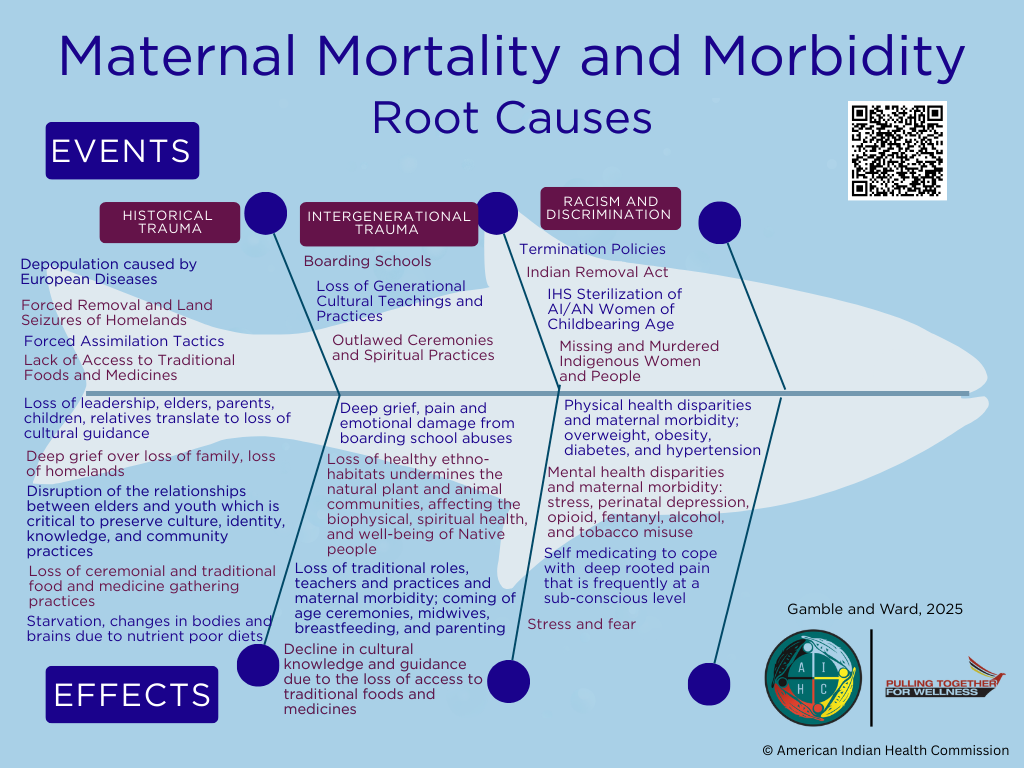
The health status of AI/AN people conflicts with their histories, traditional practices, and knowledge of their health, strength, and longevity during traditional times. It is important to understand the root causes—fundamental reason—for AI/AN health inequities. The 2025 AIHC Maternal Child Health Assessment highlights health inequities based on historical trauma and intergenerational transmission of trauma, forced assimilation, ongoing discrimination and racism, as well as inequitable access to resource. Acknowledging and understanding these are essential to unraveling the complexity of AI/AN health.
The graph from page 11 of the report outlines historical to current day events; a history of genocidal events, intergenerational trauma, and other factors that explain the root causes of the modern chronic disease rates and the physical, social, and behavioral health disparities of AI/AN people.
It was very clear that these priority groups and their issues are of high concern to the AI/AN participants. There was so much rich wisdom that was shared due to the comfort level of participants with the AIHC AI/AN consultants. The stated AI/AN priorities and concerns are at the heart of Tribal-led solutions, which will lead to healthier communities and improved mental, emotional, physical and spiritual well-being. We hope that you will follow this link to the AIHC Maternal Child Health Block Grant American Indian and Alaska Native Needs Assessment Report. Read the full report to learn how information was gathered, the common needs identified, and recommendations to begin to address those needs.
AI/AN Maternal Mortality is a Crisis in Washington State
Written by Cindy Gamble and JanMarie Ward
In AIHC’s Addendum to the Washington State Department of Health Maternal Mortality Review Panel Report to the Legislature, Tribal and Urban Indian Leadership recommended the state acknowledge that AI/AN maternal mortality of birthing people is a crisis in Washington State.
In collaboration with the National Indian Health Board (NIHB) and the Centers for Disease Control Foundation (CDCF), AIHC is working to determine whether Tribal-led Maternal Mortality Review Committees is a feasible and effective strategy in Indian Country to reduce AI/AN maternal mortality. Establishing Maternal Mortality Review Committees (MMRCs) is a responsive strategy to maternal mortality by the Centers for Disease Control and Prevention (CDC) to address maternal mortality.
What we have heard from Tribal leaders:
- Interest in the feasibility of establishing Tribal Led MMRCs in Indian Country.
- Requested efforts to increase awareness among Tribal leaders, Tribal leader organizations, and Tribal public health experts about the “The Need for Tribal Led MMRCs in Indian Country.”
- Requested more detailed information about the complex issues of maternal health, mortality and morbidity for Tribal led MMRCs to provide adequate background for Tribal/Urban Indian leaders to make decisions about effective MMRC models.
We need your guidance regarding what is needed to determine the feasibility and preferred MMRC model that would be effective for Tribes and Urban Indian Communities in Washington State. Please use this link to respond to a few questions by February 15 for a chance to win a prize in our next drawing.
For questions or additional information regarding Maternal and Family Health, please contact:
- JanMarie Ward – janolmstead@gmail.com
- Cindy Gamble – csgamble5@gmail.com
- AIHC General Inquiries – info@aihc-wa.com
Tribal Behavioral Health
AI/AN ORW Workgroup Updates
Written by Lisa Rey Thomas
The AIHC AI/AN Opioid Response/Continuum of Care Workgroup met September 9, October 14, and December 9 in collaboration with the WA Health Care Authority (HCA) Office of Tribal Affairs (OTA). We had numerous presentations, sharing of resources, and impactful discussions. You can see the meeting notes and links to resources here. We did not meet in November out of respect for Veteran’s Day. The next meeting is January 13 with presentations and discussions, including:
- Updates on kratom and 7-OH in WA from the WA Poison Control Center
- A recently released campaign on Medications for Opioid Use Disorder in WA
- New updates on the For Our Lives campaign from Desetel Hegge
If you have ideas for presentations and resources you’d like to see at upcoming meetings, please let us know!
The WA Tribal Opioid Response Task Force continued to meet as did the 5 workgroups:
- Continuum of Care
- Public Safety and the Justice System
- Community and Family Services
- Housing and Wrap Around Services
- Community Response
You can read more about this work by reading the Washington State Tribal Opioid and
Fentanyl Response Task Force Report to the Legislature. You can also learn more about the Task Force by reading this fact sheet.
Please note that we are currently planning on the 4th Annual Tribal Opioid and Fentanyl Response Summit to be held the week of September 14, 2026, specific dates and location TBD.
Ten Teams Attend First Ever WA Tribal BH Crisis Academy
Written by Kathryn Akeah
Who do your community members call in a behavioral health crisis? Who answers and who responds in person? Where is a safe place for people in crisis? These were the three key areas of focus of the first ever Washington Tribal Crisis Academy, hosted by Port Gamble S’Klallam Tribe and organized by AIHC, HCA, and Altarum.

Over 50 participants came from 10 Tribal Teams, joining 25 presenters and facilitators from the commission, state agencies, and national contractors. It was a three day event with a mix of large group presentations, small group breakouts, and individual team planning time.
Each team walked away with three goals and specific next steps to build or expand crisis response in their Tribal Community.
AIHC, HCA and DOH will be supporting the teams as they continue their work into 2026 and looking for additional training and opportunities to gather again. Participants remarked on how valuable and encouraging it was to meet in person and hear from other teams. Several workgroups will come out of the Academy and invites will be sent out in 2026 for topics such as BH codes, crisis coordination protocols, and standing up crisis teams.
One-on-one assistance is also available to any Tribal BH or services program interested in learning more about Tribal BH Crisis Response. For more information, contact AIHC Consultant, Kathryn Akeah, at kathrynakeah@gmail.com.
Certified Peer Support Specialists Webinar
Peers can be a great part of any program because they know what your clients are going through, they’ve been there. Setting up and expanding peer programs can be tricky due to rapidly changing information. To help update Tribal staff and managers, AIHC partnered with HCA’s OTA and Recovery Support Services team to offer a webinar on Certified Peer Support Specialists (CPSS), formerly known as Certified Peer Counselors. The new CPSS credential is necessary to bill Medicaid for peer services, and this webinar covered the ins and outs of requirements, credentialing, billing, supervision and training. To view the recording, click here! (Passcode: g2=J@Qe1)
Access to Healthcare Revenue
Enhanced Tribal Assister Support Program Updates for 2025
Written by Laura Kluever
The Enhanced Tribal Assister Support program is celebrating a successful first year of operations, reflecting significant growth and strengthened assistance for Tribal Assisters across the state. Prior to the program’s launch on November 18, 2024, Tribal Assisters did not have access to the dedicated support necessary for carrying out their responsibilities effectively.
From November 2024 through October 2025, the number of Tribal Assisters increased from 106 to 169, supported by the addition of five new tribal facilities. This expansion has contributed to better service delivery and increased capacity within tribal communities.
Throughout the program’s first year, 653 Tribal Assisters received support, including assistance with new registrations, job‑shadow coordination, and general program questions. The role and resources available through the Enhanced Tribal Assister Support program continue to grow, meeting rising demand and ensuring Tribal Assisters receive reliable guidance.
It is my pleasure to help with the Tribal Assister Program. This first year has shown tremendous growth, and I look forward to continuing to strengthen the program’s impact.
For questions or additional information regarding Tribal Assister support, please contact:
- Laura Kluever – laura.kluever@aihc-wa.com
- AIHC General Inquiries – info@aihc-wa.com
AIHC Provides Update on the Upcoming Expiration of Enhanced Advanced Premium Tax Credits and Guidance for Tribes and AI/AN Individuals
Written by Laura Kluever and Heather Erb
Washington State — December 30, 2025 — The American Indian Health Commission for Washington State (AIHC) is issuing an important update regarding the December 31, 2025 expiration of the Affordable Care Act’s Enhanced Advanced Premium Tax Credits (ePTCs), a development that has raised significant concerns among Tribes, Tribal assisters, and Indian health care providers across the state.
AIHC recognizes that confusion and misinformation continue to circulate regarding how the expiration of these enhanced tax credits may affect Tribes and American Indian/Alaska Native (AI/AN) individuals. To address these concerns, AIHC is committed to ensuring that Tribes and Indian health partners receive reliable, up‑to‑date information specific to Washington State.
Over the coming months, Washington residents may expect additional updates on changes to plan availability, premiums, and levels of financial assistance as federal and state policy landscapes continue to evolve. AIHC is working closely with the Washington Health Benefit Exchange (WHBE) to answer frequently asked questions and support Tribal communities through anticipated adjustments to premium sponsorship programs, plan selection processes, and client outreach strategies.
Key Recommendations for Protecting AI/AN Health Coverage
To help prevent disruptions to AI/AN health coverage, AIHC offers the following guidance:
- Utilize Tribal Assisters During Enrollment: AI/AN individuals are strongly encouraged to work with Tribal assisters when enrolling in coverage through WA Healthplanfinder. Their support is especially important as the plan selection process grows increasingly complex.
- Contact AIHC or WHBE With Questions: For questions regarding ACA Marketplace changes, including the expiration of ePTCs, Tribal assisters and community members may contact:
- Laura Kluever — laura.kluever@aihc-wa.com
- Charlene Abrahamson — Charlene.abrahamson@wabexchange.org
- AIHC general inquiries — info@aihc-wa.com
- Attend Regular WHBE Meetings: Tribal assisters should continue attending their scheduled meetings with WHBE to stay current on important updates
Legislation
2026 Legislative Priorities
Download our priorities one-pager here or watch our AIHC legislative team discuss here.
Visit Our Legislative Process page for more information.
2026 AIHC Legislative Day
Wednesday, January 21 – Interested in joining us in Olympia? Fill out this interest form here.
For more information, contact:
- Ashley Lowe-Thaens, AIHC Legislative Administrator – ashley.lowe-thaens@aihc-wa.com
- Maria Ness, AIHC Legislative Liaison – maria.gardipee@outlook.com
Administrative
Looking for more information on your role as a delegate or how to use OnBoard? Use our navigation guide: